Techniques

An explanation of Optical Photothermal Infrared Spectroscopy and related techniques.

What is Optical Photothermal IR (O-PTIR) spectroscopy

Co-propagating Mode

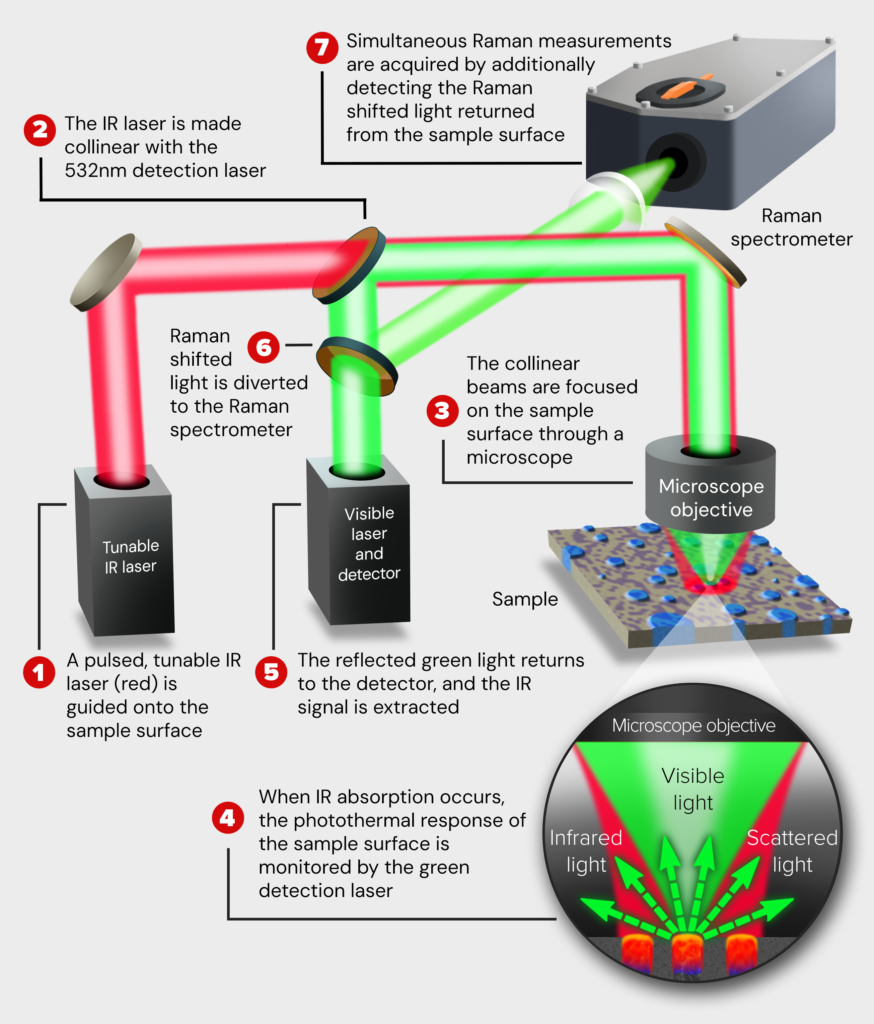
The O-PTIR technique overcomes the IR diffraction limit associated with traditional IR microscopy techniques by illuminating the sample with a mid-IR pulsed tunable quantum cascade laser (QCL) and measuring infrared absorption, indirectly with a visible laser beam.

When the QCL laser is tuned to a wavelength that excites molecular vibrations in the sample, absorption occurs, thereby creating photothermal effects, e.g., sample surface expansion and a change in refractive index. The visible probe laser, focused to sub-micron spot size, measures this photothermal response via a modulation induced in the scattered light, as shown in the video.

The IR laser can be swept through the entire range in under two seconds to obtain an IR spectrum.

Non-contact reflection IR measurement with FTIR-quality spectra and no artifacts

Fast, easy to use with little to no sample preparation and spectroscopy in seconds

Overcomes the limitations of Raman spectroscopy

Infrared resolution compared to the visible light probe

The illustration shows the variable spatial resolutions in common IR microscope systems over the traditional infrared range using two IR objectives of 0.5 or 0.7NA versus the constant spatial resolution of the O-PTIR technique using a 0.78NA objective (Kansiz, 2020). The O-PTIR technique provides wavenumber independent spatial resolution over the entire mid-IR range due to the use of a fixed wavelength probe beam at 532nm.

Counter propagating mode

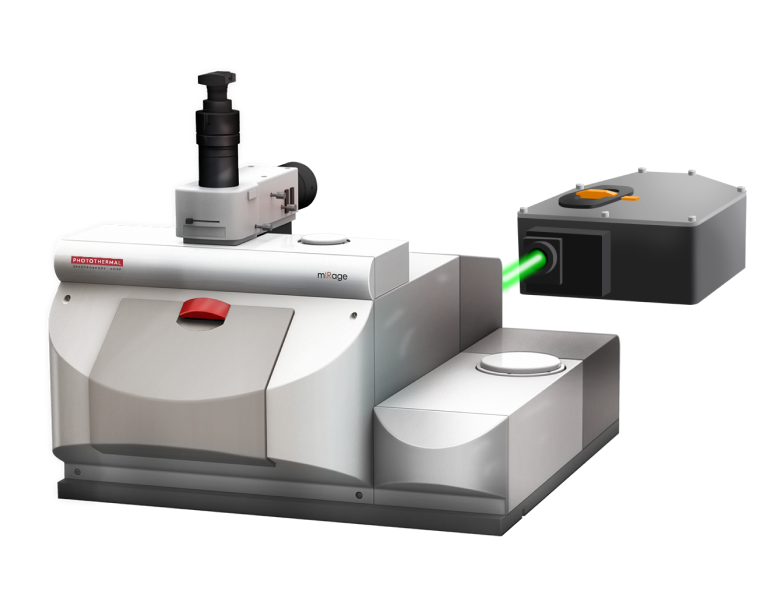
An additional major innovation with the mIRage-LS platform is the addition of a new high spatial resolution IR mode, termed “counter-propagating” mode as seen in the image.

The key enabler of the higher spatial resolution is the ability to utilize regular high power glass objectives as the probe focus optic. Unlike “co-propagating” mode where all-reflective Cassegrain optics are used to focus both the IR pump and visible probe beam, the two beams are decoupled with the IR beam directed via the underside of the sample, allowing for high power glass objectives to be used to delivery and collect the probe beam.

The counter propagating method retains all the benefits of O-PTIR while also providing for increased spatial resolution and greater experimental flexibility.

What is Simultaneous IR and Raman spectroscopy

The visible probe laser of the mIRage also generates Raman scattered light from the same measurement area, which when collected, allows for the simultaneous acquisition of both IR and Raman spectra, with the same submicron spatial resolution, at the same location and at the same time. A schematic diagram for this optical beam path is shown in image. With this simultaneous measurement capability, researchers can utilize the complementary nature of both techniques and provide confirmatory spectral information for more accurate measurements.

Simultaneous IR and Raman spectral searching with 2D search result representation with KnowItAll®

With the advent of simultaneous submicron IR+Raman spectral acquisition, as seen in the schematic representation, not only are the IR and Raman spectra simultaneously collected, but now the spectral search of both IR and Raman spectral occur simultaneously, with a single click from the data acquisition software.

Furthermore, to aid in evaluating the results, the IR and Raman hit lists are presented in a 2D scatter plot, with the IR Hit Quality Index (HQI) plotted on one axis and the Raman HQI plotted on the other axis providing researchers with the most likely material for the sample under test.

Co-located O-PTIR and fluorescence microscopy

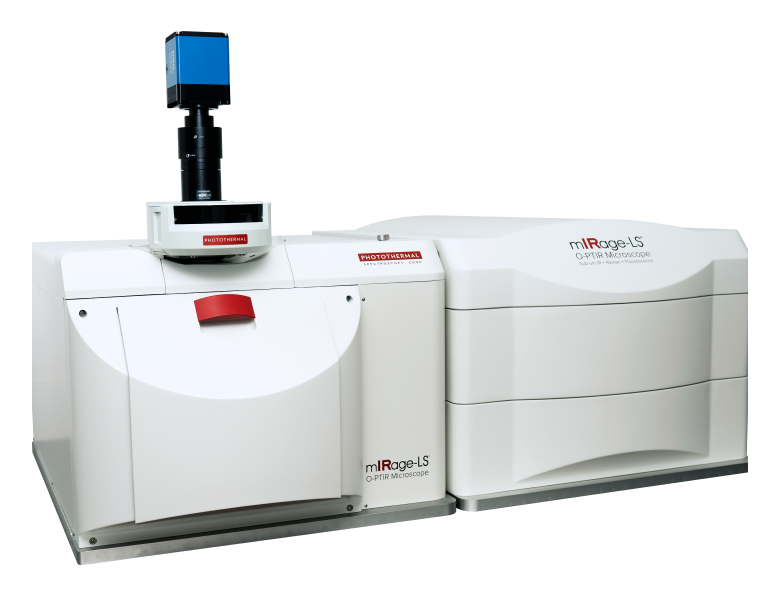
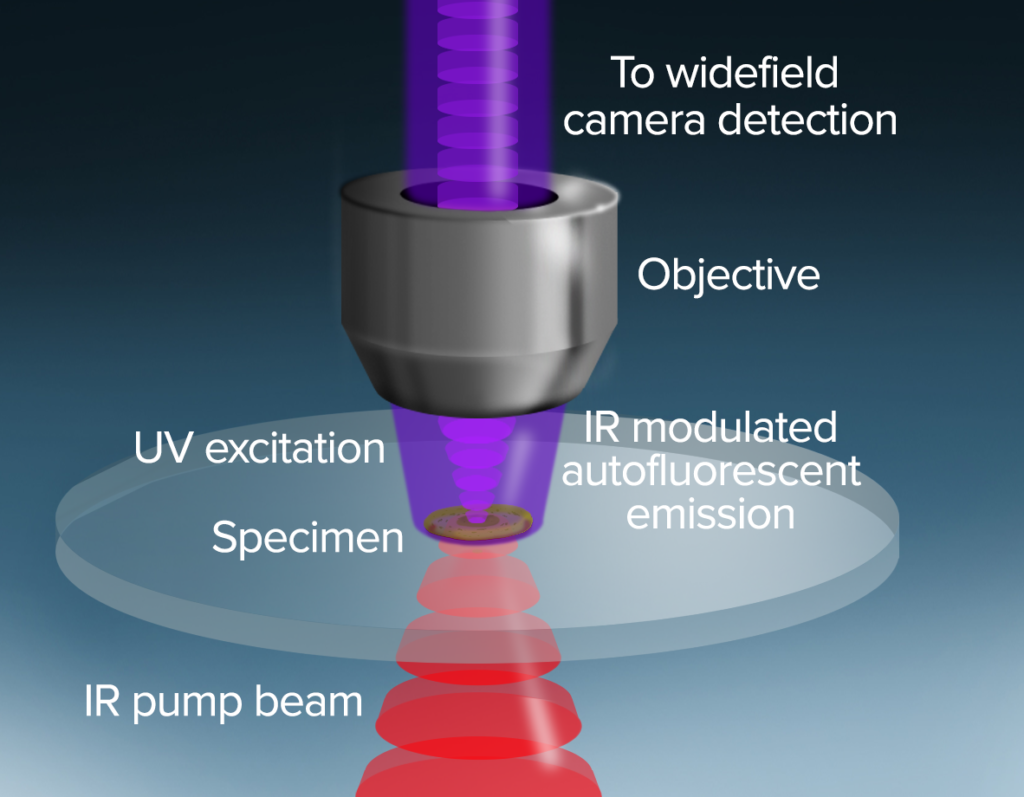
mIRage-LS principal of operation: O-PTIR and fluorescence microscopy. The mIRage-LS provides an integrated Fluorescence camera in the optics path of the O-PTIR signal. This enables co-located O-PTIR and fluorescence microscopy.

Fluorescence images can be obtained by exciting the region of interest (ROI) with different visible wavelengths and detecting the radiation re-emitted at longer wavelengths. Fluorescence imaging has been used for a long time in both life and material science.

The excitation and emission wavelengths of a given molecule are directly related to its inherent electronic states but would not affect O-PTIR data acquisition (Qin, 2020; Chen, 2022). As a result, widefield FL images can first map out the ROI before collecting the spatially resolved chemical information by submicron O-PTIR.

The system layout for a combined O-PTIR sub-micrometer IR microscope, co-located with fluorescence microscopy is illustrated to the right. In counter propagating mode, the pulsed IR beam is directed through the underside of the sample. The fluorescence and visible probe beam paths are co-located through the microscope objective.

FL-PTIR: How it works

FL-PTIR works by using temperature-dependent changes in fluorescent emission intensity to detect the subtle heating associated with chemically specific infrared absorption by a sample. Commercial fluorophore dyes, fluorescent proteins and naturally occurring fluorophores all have a strong temperature dependence in their emission efficiency (quantum yield), on the scale of ~1%/°C.

When a sample is exposed to pulses of IR light, IR absorbing regions of the sample heat up slightly and decrease the fluorescent emission from the heated regions. FL-PTIR uses a high-sensitivity s-CMOS camera to detect changes in fluorescent emission intensity from the sample in response to pulses of IR light from a wavelength tunable IR laser.

By comparing fluorescent emission camera images of the sample with and without the IR pulses, the mIRage-FL calculates widefield IR absorption images, while simultaneously capturing co-located fluorescence emission images.

Hyperspectral image arrays, i.e., an array of IR absorption images at different IR wavelengths, can be rapidly acquired in minutes. The hyperspectral arrays can then be analyzed to extract IR absorption spectra from any region of the image. IR chemical images and ratio images can be created by integrating the image stack over desired IR absorption bands.

The Phase Signal

The Phase channel plots the phase delay of the O-PTIR signal from the lock-in amplifier. Changes in phase indicate a difference in the delay between the IR pulse and the photothermal response of the sample. The phase signal is primarily indicative of the thermal time constant of the material under study. In some cases the phase signal can provide additional/complementary contrast to help identify regions that are different from their surroundings and may warrant additional investigation. The figure shows an example of using the phase channel to identify different material components in a biological cell. In this case the lipids in the cell showed significantly different phase than the surrounding protein.

Applications
Our products

Fluorescence guided sub-micron IR and simultaneous Raman spectroscopy: A world first and only

Simultaneous, submicron IR and Raman microscopy O-PTIR and Raman microscope combined.

Sub-micron IR sub-micron IR spectroscopy and imaging with FTIR quality data.

Webinars

Need more information?

Discover how O-PTIR technology can elevate your research or help solve your toughest challenges. Our team are happy to assist and answer your questions.