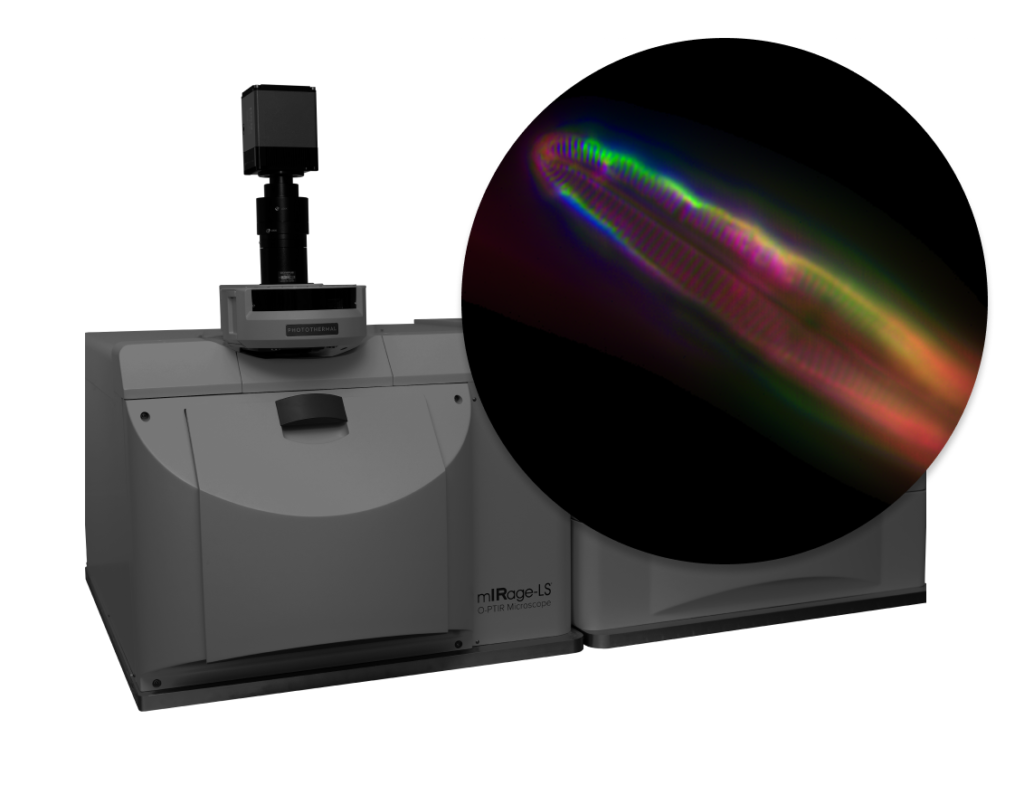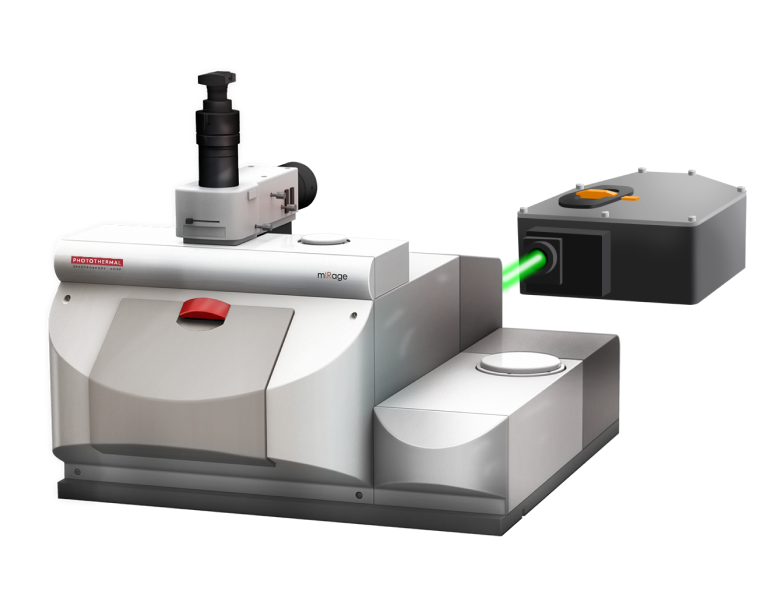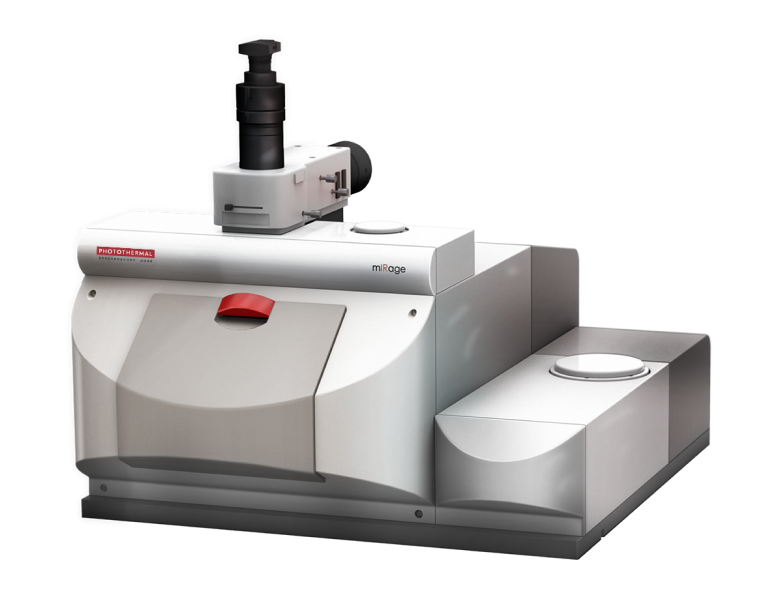
mIRage®-LS

Fluorescence guided sub-500nm IR and simultaneous Raman spectroscopy: A world first and only

The mIRage-LS platform revolutionizes life science research by combining co-located O-PTIR and fluorescence microscopy. Fluorescence microscopy provides molecular specificity, while vibrational spectroscopy (IR and Raman) offers spatially resolved macromolecular characterization. The integration of these techniques enables researchers to explore biological samples with unmatched detail.

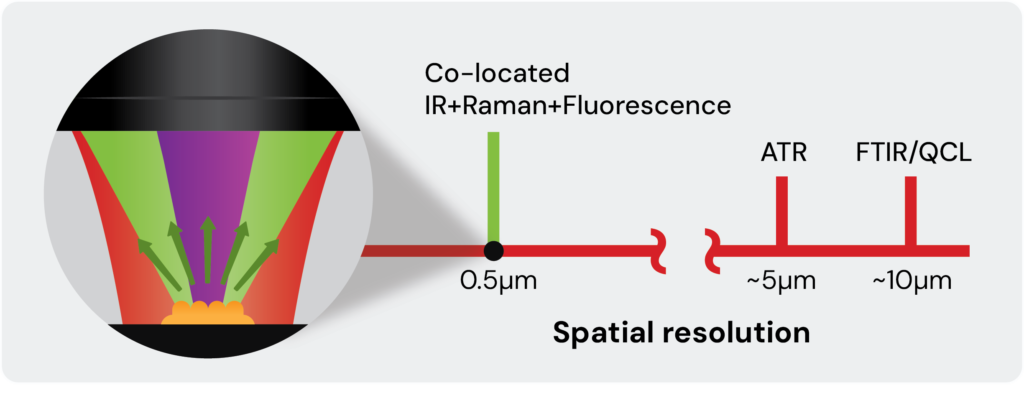
With O-PTIR’s submicron resolution and simultaneous Raman capabilities, the mIRage-LS achieves IR spectroscopy at scales <500 nm, matching Raman and fluorescence imaging resolutions. This seamless, registration-free platform synergizes these methods, unlocking deeper molecular insights and enabling transformative discoveries unattainable with either technology alone.

Co-located Fluorescence microscopy and sub-micron O-PTIR spectroscopy

Sub <500nm IR chemical spatial resolution

Fast fluorescence identification and imaging of cells, tissues, bacteria

Wide range of applications

Tissue and cell imaging

  • Single Cells: normal/diseased cell differentiation, drug-cell interactions, intra-cellular (lipid droplet) imaging studies
  • Tissues; cell typing, calcifications, disease state, collagen orientation
  • Bacteria; Bacterial identification at the single cell level, cell metabolism studied with stable isotopic labelling (13C, 15N, Deuterium)

Co-located fluorescence + sub-micron IR of cells

Neuroglioma cells were stained with G3BP1 for protein stress granules, DAPI for nucleus and BODIPY for lipids.

Image: RBG overlay widefield epi-fluorescence image with red showing protein stress granules, Blue showing nucleus and Green showing lipids. Square markers show locations of O-PTIR spectral collection.

The right side shows the brightfield image. Square markers show locations of O-PTIR spectral collection.

The O-PTIR spectra was collected in seconds from the marker locations shown in the left and middle panes. Clear spectral differences can be observed, consistent with the targeted sub-cellular features. Of particular note, is the subtle shift in the Amide I band of the protein stress granule indicating a likely different protein secondary structure to the other locations.

Using fluorescence to localize O-PTIR measurements

An Alzheimer’s disease mouse model brain tissue section was stained with Amytracker 630 to highlight amyloid aggregates, AF488 to highlight proteins and DAPI for the nucleus.

In the figure to the left is shown a brightfield image of the stained sample. In the top right is the RBG composite fluorescence image, which highlights in red/orange the regions of amyloid aggregation. Note how some amyloid aggregates highlighted in the fluorescence image are not readily distinguishable in the brightfield image.

At the bottom is an averaged O-PTIR spectra, from the line profile indicated in the fluorescence image, with spectra averaged on (in blue) and off (in red) the aggregate. The average spectrum of the aggregate shows distinct spectral differences in the amide I band with a significant spectral feature at 1631cm-1, typical of protein beta sheet structures.

This clearly demonstrates the utility of combining fluorescence imaging to highlight regions of amyloid aggregation, some of which cannot be readily seen in brightfield microscopy, with submicrometer O-PTIR spectroscopy which can then provide the molecular compositional information, in this case, being particularly sensitive to protein secondary structure, a characteristic strength of IR spectroscopy.

Application note:

Sub-500nm IR microscopy and
spectroscopy with co-located fluorescence imaging for life science applications

Webinar:

New sub-500nm IR with simultaneous Raman and co-located fluorescence microscopy

Data sheet:

mIRage-LS, sub-500nm IR multimodal microscope

Applications
Our products

Widefield fluorescence detected sub-500nm infrared multimodal microscopy

Simultaneous, submicron IR and Raman microscopy O-PTIR and Raman microscope combined.

Sub-micron IR sub-micron IR spectroscopy and imaging with FTIR quality data.

mIRage accessories

mIRage Spectroscopy options

Counter-propagating mode and other mIRage spectroscopy capabilities to extend research flexibility.

Multi-modal Imaging options

Complimentary O-PTIR techniques such as simultaneous Raman and co-located Fluorescence.

mIRage Environmental options

mIRage environmental options broaden the applications range with heating, cooling and flow cells. 

Need more information?

Discover how O-PTIR technology can elevate your research or help solve your toughest challenges. Our team are happy to assist and answer your questions.