Biopharma
Detection and chemical ID of smaller sub-visible, even sub-micron particulates in pharmaceutical formulations is becoming increasingly important. Sub-micron, multi-modal O-PTIR address this problem with its unique approach to spectroscopy and microscopy of defects and particulates.
Why O-PTIR for biopharma research?
Particulate matter in sterile pharmaceutical formulations presents a serious health challenge with potentially severe consequences for patients. Additionally, protein aggregates and proteins adsorbed to foreign microparticles in therapeutic protein products increase immunogenicity, diminishing therapeutic response. Consequently, regulatory authorities are requesting that the characterization and visualization of sub-micron particles be incorporated into the particle control strategies. Read more about how the mIRage-LS helps address this problem.
Integrating sub-micron chemical and morphological analysis into routine particle control strategies is now a reality with mIRage-LS, submicron multimodal IR microscope. Routine analysis of submicron chemical and morphological analysis of particulate matter and particles enablesCritical Quality Attributes (CQA) to be established that contribute to quality, safety and efficacy of infusion and injection formulations.
Moreover, submicron (O-PTIR) spectra collected on highly fluorescent biologic matrices, traditionally considered challenging to impossible with tools like Raman microscopy, are now completely unaffected, enabling robust submicron chemical characterization and particle visualization of aggregates and particulate matter.
Here we describe how multi-modal O-PTIR has been employed to investigate Particulate Matter in Protein Therapeutics Formulations
Particulate Matter in Protein Therapeutics Formulations
Fast Screening: Full-Range submicron IR Spectra in seconds
- Large particle, #1 (~20 µm) shows dominant proteinaceous structure
- Primarily beta sheet secondary as evidenced by amide I protein spectral band position at ~1645 cm-1
- Smaller spectral features at 1584 and 1467 cm-1 due to heterogenous presence of Free Fatty Acid (FFA), oleic acid, a PS80 formulation degradation by-product
- Small particle, #2 (~5 µm) shows primarily FFA (oleic acid) spectral features
- Dominant features at 1584 and 1467 cm-1
- Strong in C-H stretching bands (3000-2800 cm-1)
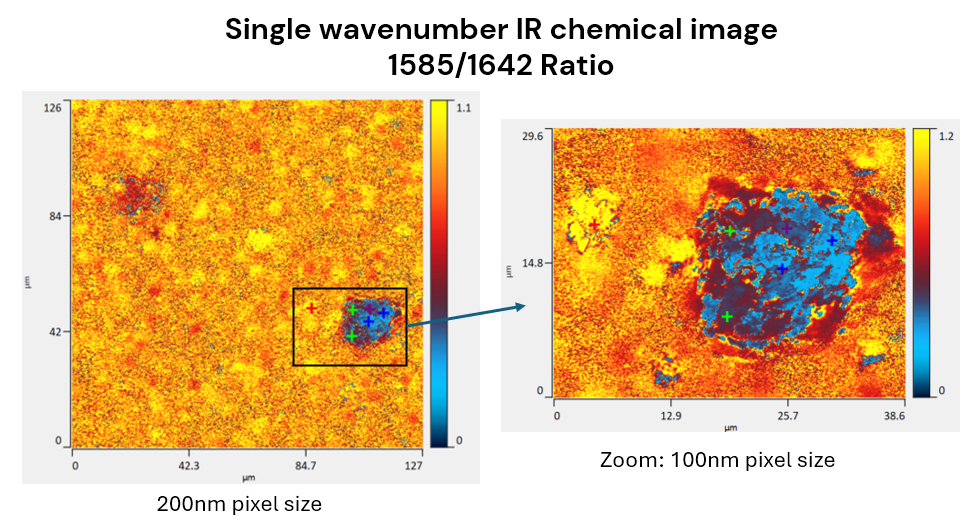
Composite Particles: Single-Frequency Chemical Imaging
- Chemical image reveals ~5 µm FFA particle (with protein) and ~20 µm proteinaceous aggregate (with FFA inclusions weighted to the left-hand side of the particle)
- Sub-micron IR chemical imaging has shown intraparticle heterogeneity
Fluorescence imaging & IR spectroscopy
Whilst filtered particulate matter in the brightfield image has limited contrast, the biological nature of these protein aggregates provides for strong autofluorescence imaging, significantly increasing their contrast, allowing for more accurate particle sizing and statistics as well as providing for more accurate locating for subsequent IR spectroscopy.
The sub-micron IR (O-PTIR) spectra are collected from particles as small as ~1 µm in size with excellent spectral sensitivity with measurements times less the 5 sec per spectrum.
Clear secondary structural differences are evident based on the differences in shape of the Amide I band (~1660 cm-1) with these differences being most prominent for the larger particles which also spectral differences at ~1000 cm-1.
Protein specific IR chemical imaging & IR spectroscopy
Ratioed single frequency ratio images (1641/1587 cm-1) highlight only the proteinaceous particles providing for a more selective, targeted for protein chemical image. Full range IR (O-PTIR) spectra of these protein particles shows differences in protein secondary structure (beta sheet vs alpha helical) with differences in silicon oil content also being observed
Webinar:
Simultaneously multi-modal (IR/Raman/FL) sub-micron IR (O-PTIR) spectroscopy for life science and biopharma applications
- Biopharma
Submicron IR+Raman analysis of biopharmaceuticals
- December 11, 2024
- Biopharma / Microplastics
Advances in submicron IR and simultaneous Raman for Microplastics Characterization
- September 30, 2024
- Biopharma
Simultaneously multi-modal (IR/Raman/FL) sub-micron IR (O-PTIR) spectroscopy for life science and biopharma applications
- December 6, 2023
Need more information?
Discover how O-PTIR technology can elevate your research or help solve your toughest challenges. Our team are happy to assist and answer your questions.