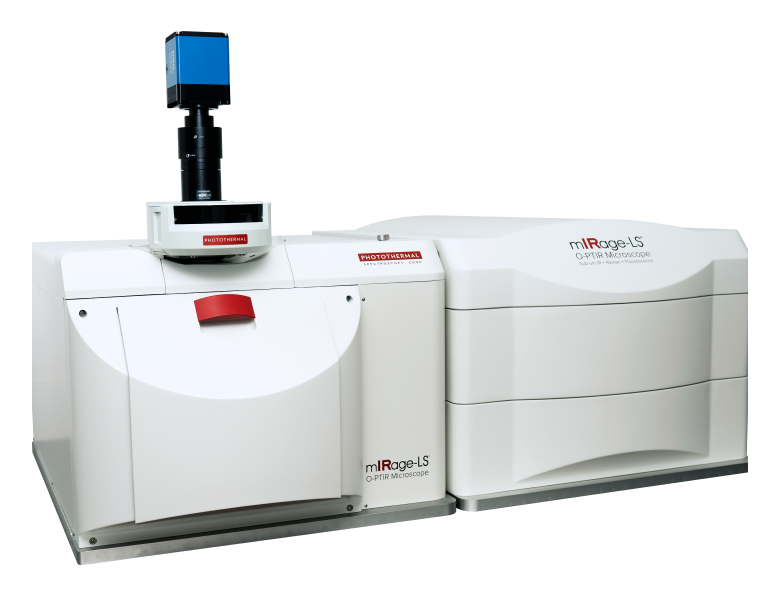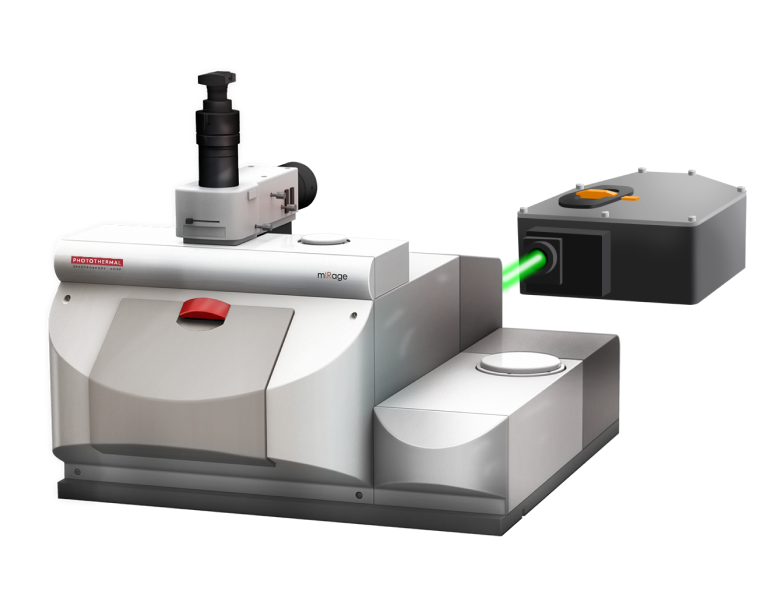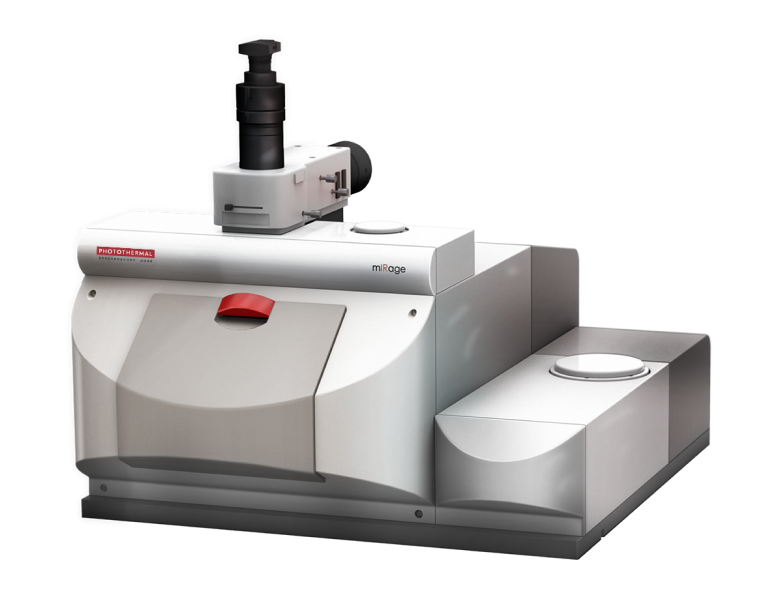
Widefield O-PTIR™

Widefield fluorescence detected sub-500 nm infrared multimodal microscopy

[youtube_privacy_video link="https://youtu.be/An8anbVOgO8"]

High speed, label free, chemical imaging

Widefield O-PTIR™ is a new sub-micron IR, high-speed widefield chemical imaging mode for measurement of a wide range of labelled and auto fluorescent samples covering cellular, bacterial and tissue applications.

A major advantage of widefield O-PTIR is its fast (snapshot) single IR wavenumber and hyperspectral imaging speed. It is up to 50x faster than standard O-PTIR, with typical image acquisition times of <1-10 seconds for single wavelength IR images and minutes for hyperspectral IR arrays, with measurement speeds of up to 5 FPS for dynamic single frequency chemical IR imaging.

high speed chemical imaging of fluorescently labeled and autofluorescent samples

single wavelength chemical images in seconds and hyperspectral arrays in minutes

dynamic chemical imaging up to 5 frames per second

Fluorescently labeled, autofluorescence, IR tagged, or label-free experiments

The possibilities for life science measurements are endless. mIRage-LS with widefield O-PTIR supports a broad range of experimental set up and sample types. Whether your samples are fluorescently labeled, label-free, auto fluorescent or you are detecting molecules with IR tags, the mIRage-LS now supports virtually all biological image contrast enhancement tools, making the system one of the most flexible vibrational spectroscopy platforms available for a broad range of life science research.

Label-free chemical imaging

For experiments where fluorescence labelling is undesirable, or autofluorescence does not occur, one can uniquely perform true label-free chemical imaging with sub-500nm O-PTIR, relying in the inherent chemical contrast through direct detection of macromolecules such as proteins (and their secondary structure), lipids, nucleic acids, carbohydrates and more.

IR tags for enhanced molecular specificity

Increasingly as researchers are requiring the spatial specificity that labelling provides, the use of IR tags is growing in popularity. IR tags provide the sought after spatial specificity, but being much smaller in molecular weight and size, they provide opportunities to follow and study small molecule metabolism, without perturbations that would not be possible with conventional bulky fluorescent labels.

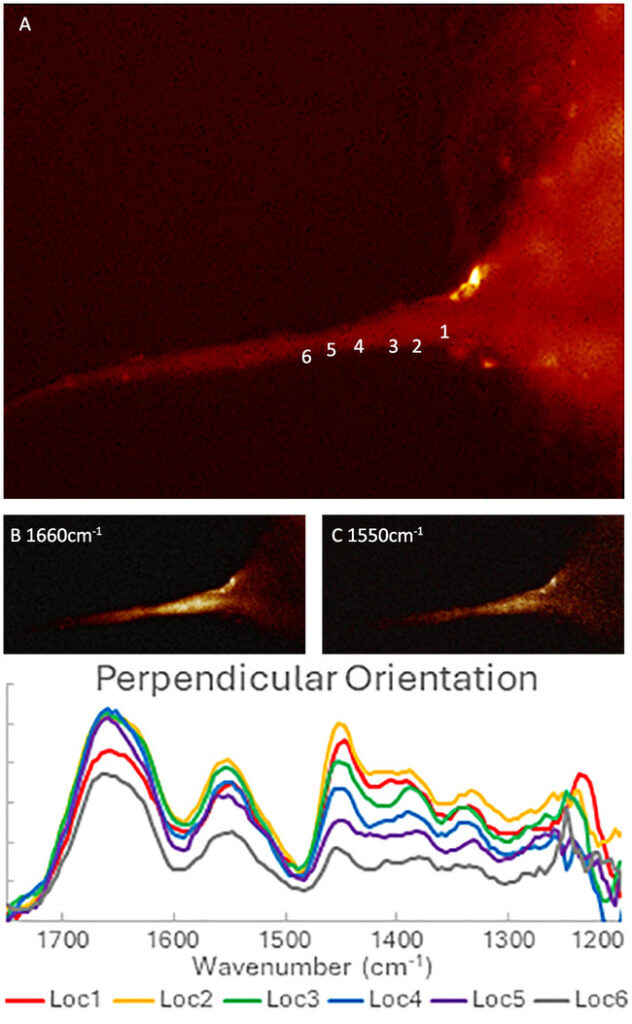
Image: Widefield OPTIR measurements on an autofluorescent collagen fibril at different orientations. (A) Autofluorescent emission image of collagen fibril excited at 365 nm. (B-C) FL-PTIR absorption images at 1660 cm-1, 1550 cm-1,  respectively. (D) FL-PTIR spectra extracted from an IR hyperspectral image stack from the indicated regions of interest for IR radiation oriented substantially perpendicular (E) to the fibril. (Sample courtesy of Prof. K Gough, University of Manitoba).

Label free measurement of autoflourescent samples

Autofluorescence is your new best friend

Until now, those practicing vibrational spectroscopy with Raman and fluorescence microscopy were often at the mercy of unwanted sample autofluorescence, which can be a severe interferent. With FL-PTIR, autofluorescence becomes a major enabler and sensitivity enhancer providing a path to label-free chemical imaging for many biological sample types.

Widefield O-PTIR imaging of live yeast cells in water

IR absorption @1035 cm-1

Fluorescently labeled with fluorescein diacetate, a living cell indicator

Measurement of dynamics over 15 minutes (Speed up 450X). 2s per image

High resolution, high quality spectroscopy and chemical imaging

Diatom Image above: Image ratio at 1200/1072 cm-1 with a 80 cm-1 peak integration width. Green box shows size of 260 nm 2×2 pixel ROI used to calculate spectra below. Dashed line shows approximate location of cross-section measurements.

The IR spectra above is from 260 nm regions of interest with the positions indicated. Note both the substantial spectral variation over 260 nm length scales and spectral similarity in the alternating regions of the periodic structures (striae) in the diatom frustule. Spectra are normalized to 1072 cm-1.

Demonstration of sub-500 nm spatial resolution. The plot above shows the intensity of 1260 cm-1 IR band measured at single pixels along the white dashed line.

Data sheet:

Widefield Fluorescence-detected sub-500nm infrared multimodal microscopy

Webinar:

Sub-500nm, widefield IR (O-PTIR) chemical and simultaneous fluorescence imaging

Publication:

Widefield Super-Resolution Infrared Spectroscopy and Imaging of Autofluorescent Biological Materials and Photosynthetic Microorganisms Using Fluorescence Detected Photothermal Infrared (FL-PTIR)

Applications
More products

Fluorescence guided sub-micron IR and simultaneous Raman spectroscopy: A world first and only

Simultaneous, submicron IR and Raman microscopy O-PTIR and Raman microscope combined.

Sub-micron IR sub-micron IR spectroscopy and imaging with FTIR quality data.

Need more information?

Discover how O-PTIR technology can elevate your research or help solve your toughest challenges. Our team are happy to assist and answer your questions.